
Has a sudden twist or impact left your knee unstable and painful? You’re not alone. Medial collateral ligament issues are common, especially among active individuals.
Navigating the healing process can feel overwhelming without a clear plan. That’s where a structured rehabilitation approach becomes your most powerful tool.
At JACO Rehab on Oahu, we believe in a personalized road to recovery. Our physical therapists dedicate over 50 minutes in each one-on-one session to your specific needs.
This guide breaks down the essential stages of healing. We’ll walk you from the initial injury management all the way to confident return-to-sport performance.
Our evidence-based methods prioritize your long-term function. The goal is a full return to the sports and activities you love.
Key Takeaways
- A clear, phased plan is crucial for effective healing from a medial collateral ligament injury.
- Personalized, one-on-one care addresses your unique knee condition and recovery goals.
- Evidence-based protocols guide each stage, ensuring safe and progressive rehabilitation.
- Setting realistic milestones keeps motivation high and tracks your improvement.
- Successful rehab culminates in return-to-sport testing and performance training.
- Commitment to the process is the key to regaining full strength and stability.
- Professional guidance helps prevent re-injury and promotes long-term joint health.
Introduction to MCL Sprain Rehabilitation
A structured rehabilitation program is the cornerstone of healing after a medial collateral ligament injury. This journey back to full function demands a clear and dedicated plan. We guide you through each step with a focus on safety and long-term results.
Successful recovery requires your full commitment to the program. It also needs strict adherence to activity modifications from your physical therapist.
Our Approach to Safe Recovery
Our method involves a comprehensive physical therapy program. It is designed to restore your knee function through consistent, guided sessions. We start by understanding the specifics of your ligament issue.
This allows us to set achievable goals for a full and healthy recovery. Every patient receives a structured rehabilitation plan. This plan addresses the unique demands of their specific knee condition.
We believe education is a vital part of the healing process. It helps you navigate the challenges of your recovery journey effectively. Our focus on foundational movement patterns is key.
This ensures your joint is prepared for daily life and athletic performance. The table below outlines the core elements of our strategy.
| Component | Focus | Patient Benefit |
|---|---|---|
| Personalized Assessment | Understanding your specific knee condition and injury mechanism | A rehab plan tailored to your unique needs and goals |
| Guided Exercise Sessions | Restoring function through consistent, one-on-one physical therapy | Safe progression and correct technique to rebuild strength |
| Education & Home Management | Navigating activity modifications and the healing process | Empowerment to participate actively in your own recovery |
| Progressive Goal Setting | Achieving milestones from pain reduction to return to sport | Maintained motivation and clear tracking of improvement |
This integrated approach leads you toward a confident return to the activities you love.
Anatomy and Function of the Medial Collateral Ligament
The inner knee relies on a specific, robust structure to maintain stability during movement. Knowing how it’s built and works is foundational for any recovery plan.
Overview of MCL Structure
This key ligament is not a single cord. It has a superficial, long flat band and a deep layer fused to the joint capsule.
Together, they form a thick portion of the capsule on the inner side. This design provides essential support to the entire medial aspect.
The Role of the MCL in Knee Stability
The medial collateral ligament is the primary stabilizer against inward force. It prevents excessive valgus and rotational stresses.
“The MCL is the first line of defense against valgus instability, making its functional integrity paramount for athletic performance.”
Its deep portion has direct attachments to the femur and tibia. This works with the posterior oblique ligament for comprehensive control.
We analyze this collateral ligament structure to target rehab exercises precisely. The goal is to restore the tissues responsible for joint stability.
| Component | Anatomical Description | Key Function |
|---|---|---|
| Superficial Layer | Long, flat band running along the inner knee | Resists valgus stress during dynamic movement |
| Deep Layer | Fused to the joint capsule and meniscus | Provides rotational stability and medial support |
| Posterior Oblique Ligament | Reinforces the posterior corner of the medial collateral | Controls knee hyperextension and posterior glide |
This detailed understanding guides our approach to healing your knee effectively.
Mechanisms Behind MCL Injuries and Sprains
Two primary mechanisms lead to damage of the medial collateral ligament: indirect force and direct impact. Knowing which one caused your condition helps us tailor the recovery strategy effectively.
Non-Contact vs. Direct Trauma
Many knee issues happen without any collision. A sudden twist or awkward landing can force the joint inward.
This rotation places immense stress on the inner portion of the knee. It’s a common cause of non-contact injuries in basketball or skiing.
Direct trauma involves a blow to the outer leg. This frequently occurs in contact sports like football and rugby.
The force pushes the knee inward, overstretching the medial structures. Such injuries often require immediate assessment and care.
Chronic stress from repetitive movement patterns also matters. Surfers or gymnasts may develop issues over time.
We analyze your specific injury mechanism to build a protective program. This approach is supported by research on knee injury mechanisms.
Our goal is to correct faulty mechanics that lead to these common injuries. This reduces your risk of future knee problems.
Assessing Injury Severity and Grading
Not all knee ligament issues are the same, which is why we classify them into distinct grades. This classification guides every decision in your recovery plan.
Accurate grading determines the right path forward. It tells us if you need gentle care or a more intensive approach.
Understanding Grade 1 to Grade 3 Injuries
The mildest category is a grade 1 injury. It involves tenderness with minimal joint looseness.
A grade 2 issue means partial ligament disruption. This causes noticeable laxity in the knee.
The most severe is a grade 3 injury. It represents a complete ligament tear.
These severe injuries often damage other structures. Nearly 80% involve issues like ACL tears or meniscus damage.
We perform thorough exams to find all related injuries. This complete picture is vital for your safety.
Correct grading decides between conservative care and surgery. It sets the timeline for your return to activity.
Our assessment ensures your knee condition gets the precise attention it requires.
What are MCL sprain rehab phases?
Your road back to full activity follows a logical progression of three interconnected stages.
This structured process guides your progress from the initial injury to full functional recovery. We monitor and adjust the intensity throughout.
Phase One: Managing Pain and Swelling
The first stage prioritizes controlling inflammation. We protect the healing ligament and prepare the knee for later work.
Managing pain and swelling is the foundation for all subsequent exercises.
Phase Two: Restoring Mobility and Range of Motion
Next, we focus on regaining correct joint movement. The goal is to ensure your knee moves without excessive stiffness.
Restoring full mobility and motion is essential for normal function.
Phase Three: Building Strength and Function
The final period is dedicated to developing power. We prepare the joint for the demands of daily life and specific sports.
Building strength and advanced function ensures a confident return to your activities.
| Phase | Primary Focus | Key Activities |
|---|---|---|
| Phase 1 | Control inflammation & protect tissue | Pain/swelling management, gentle protection |
| Phase 2 | Restore normal joint movement | Range of motion exercises, mobility drills |
| Phase 3 | Rebuild power for daily & sport demands | Strength training, functional movement patterns |
| Ongoing Process | Monitor healing & adjust plan | Regular reassessment to ensure safe, effective rehab |
Early Stage Rehabilitation: Pain, Swelling, and Mobility
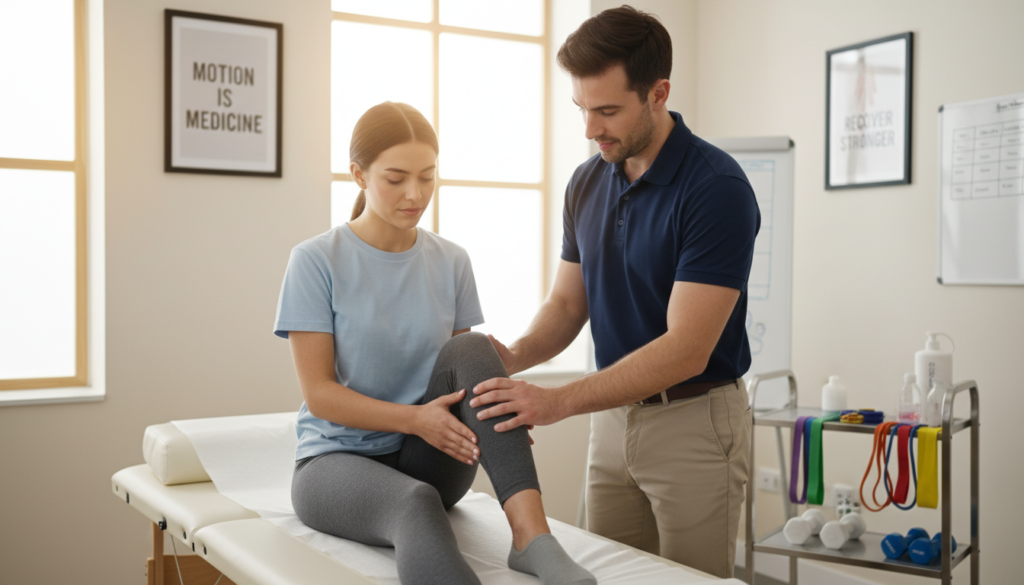
The foundation of a successful return to activity is built in these first critical weeks. Our early stage protocol focuses on specific, achievable goals to create a stable platform for healing.
We prioritize controlling inflammation, regaining joint motion, and restoring muscle function. Normalizing your walking pattern is also an essential part of this initial phase.
Acute Management Techniques
Our acute management techniques directly address pain and swelling. Reducing these symptoms allows for safe, gentle range of motion exercises to begin.
We often utilize quad sets and heel props. These simple movements improve knee extension without stressing the healing ligament.
Restoring quadriceps function is a critical early goal. Supine straight leg raises are a common tool, as they rebuild strength without placing undue load on the injured knee.
If full weight-bearing is not yet tolerable, we may introduce crutches. This support helps normalize your gait pattern and protects the joint.
Careful symptom monitoring guides every step. We ensure your early stage exercises promote healing without causing a setback.
This attentive approach in therapy prepares your knee for the more demanding work ahead.
Strengthening and Stability Exercises
Targeted strength training forms the core of our approach to restoring knee function. This phase builds upon your early mobility gains to develop durable support around the joint.
Our carefully selected movements address the quadriceps and hamstrings directly. These muscle groups are essential for absorbing impact and controlling movement.
Quadriceps and Hamstring Workouts
We often introduce progressive split squats and lateral step downs. These exercises build muscle capacity while maintaining stability in the affected knee.
Hamstring slider progressions enhance the posterior chain. This support is vital for the ligament during dynamic athletic movements.
Each activity is chosen based on your current function. We ensure you can perform them with minimal discomfort from the prior injury.
Proper form during all training prevents dynamic valgus. This faulty alignment places excessive stress on healing tissues.
By systematically increasing intensity, we prepare your muscles for sports demands. This methodical progression is key to a safe return to full activity.
Integrating Balance and Dynamic Movements
Dynamic stability training bridges the gap between basic strength and sport-specific performance. This phase challenges your body to react to unpredictable forces.
Exercises to Enhance Stability
Our focus shifts to exercises that improve neuromuscular control. This is essential for stabilizing the knee during rapid changes in direction.
We utilize drills like the 3-way RDL and the Y-balance test. These movements expose the joint to controlled rotational and lateral stress.
They are introduced only after you can stand on one leg for 30 seconds. This ensures a safe progression for your recovery from the prior injury.
Practicing these dynamic balance tasks builds the confidence needed for high-impact activities. It reduces fear of a recurrence.
Our approach ensures your knee can handle the lateral and rotational demands of your athletic goals. This final layer of stability is key for a durable return.
The Role of Physical Therapy in Our Rehabilitation Program
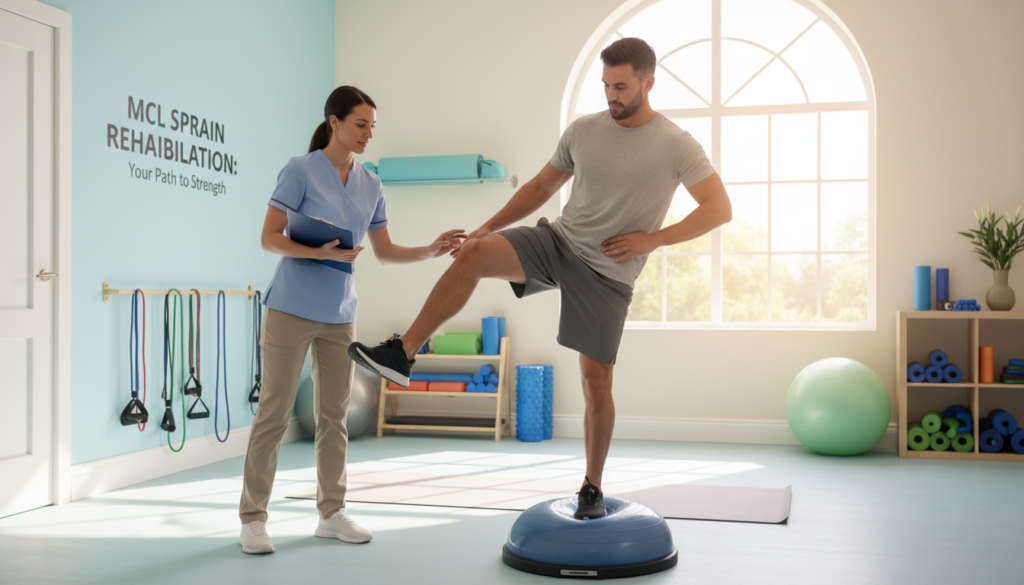
The journey back to strong, stable knees is powered by expert physical therapy and progressive treatment. This dedicated approach is the cornerstone of recovery, restoring proper joint mechanics.
It actively prevents future stiffness or muscle weakness. Our method ensures every step forward is built on a solid foundation.
Personalized Treatment and Exercise Progressions
Our physical therapy program provides plans that evolve with you. They adapt through the various stages of your knee recovery.
We work closely to ensure every exercise progression is safe and effective. Each movement aligns with your long-term functional goals.
Addressing the root cause of your ligament injury is a priority. Our therapy sessions help prevent future issues and support long-term joint health.
We monitor your response to each treatment carefully. Necessary adjustments to your program keep you on the path to success.
Consistent participation in these sessions is the most reliable way forward. It restores confidence and stability in your injured knee.
Conservative Versus Surgical Treatment Approaches
The decision between letting an injury heal naturally or opting for a surgical procedure is critical for long-term knee health. We base this choice on a detailed assessment of your specific condition.
For most isolated MCL issues, the consensus favors a conservative treatment path. This approach avoids the need for surgery and focuses on the body’s natural healing capacity.
It is typically the recommended course for grade 1 and grade 2 ligament injuries. The goal is to preserve your natural knee function whenever possible.
Criteria for Nonoperative Management
We evaluate specific criteria to determine if nonoperative care is your best path. Key factors include the level of clinical instability and your personal functional goals.
Most ligament injuries respond well to this structured, non-surgical treatment. It involves dedicated rehab to guide the healing ligament.
Surgical intervention may be indicated for a complete grade 3 tear. Specific signs include an avulsion fracture, severe valgus alignment, or persistent knee instability.
When an operation is necessary, we coordinate closely with your surgeon. This ensures the postoperative treatment protocol is followed precisely for the best outcome.
| Treatment Approach | Typical Indications | Primary Goal |
|---|---|---|
| Conservative (Nonoperative) | Grade 1 & 2 MCL injuries, minimal joint laxity | Natural ligament healing & functional restoration |
| Surgical | Grade 3 tear with fracture, chronic valgus instability, multi-ligament injury | Mechanical stabilization & anatomical repair |
Our ultimate aim is to provide the most effective knee care. We prioritize methods that avoid surgery to support your body’s innate recovery process.
Implementing Bracing and Support Measures
Mechanical support plays a pivotal role in the initial stages of knee recovery. We often introduce a hinged brace to provide essential stability.
This device protects the healing ligament from minor rotational stresses. It allows you to move with greater confidence during early exercises.
Our goal is to use the brace as a temporary tool. We guide you on proper wear times and safe removal.
Relying on external support indefinitely can hinder your natural joint stability. The brace is a bridge to independent function.
Typical use lasts between eight to twelve weeks after the initial injury. This timeline aligns with the ligament’s biological healing process.
Increased confidence is a key benefit. It reduces fear of re-injury during necessary physical therapy movements.
Our support measures are designed to complement your strengthening program. They ensure your knee remains protected while you build durable function.
| Recovery Phase | Brace Use Focus | Patient Goal |
|---|---|---|
| Early (Weeks 1-4) | Full-time wear for joint stabilization and protection | Control pain, reduce swelling, initiate gentle motion |
| Mid (Weeks 5-8) | Partial wear during daily activities and exercise | Restore full range of motion, begin light strength work |
| Late (Weeks 9-12) | Discontinued for daily use; may be used for high-risk activities only | Build advanced strength and prepare for sport-specific demands |
This structured approach to bracing supports your medial collateral ligament recovery. We ensure it integrates seamlessly with your overall rehabilitation plan.
Transitioning to Sport-Specific Training
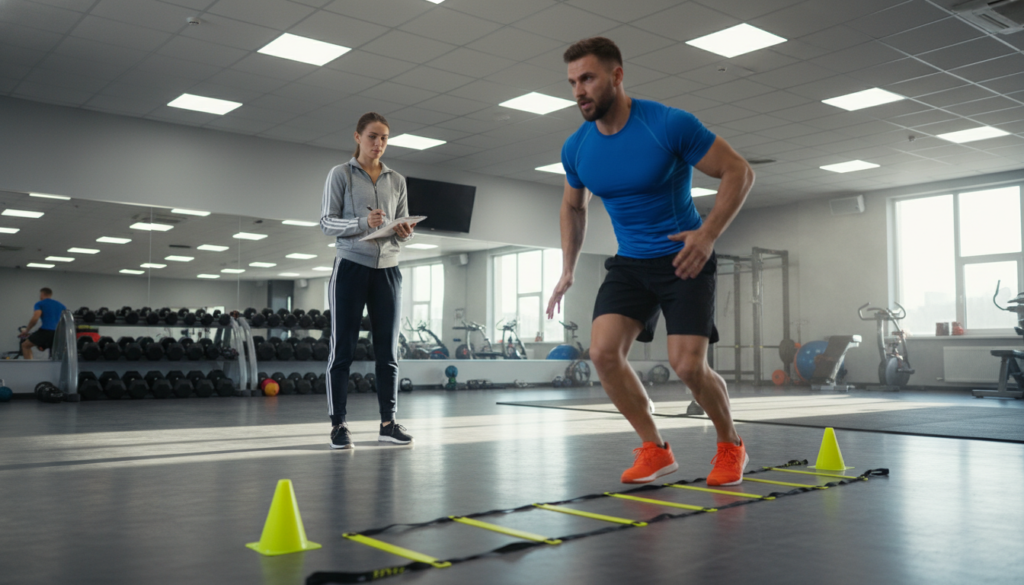
Agility and stability testing provides the objective green light for a return to your sport. This final phase shifts focus from general recovery to preparing your joint for the unique demands of competition.
We use a battery of performance trials to ensure your healed knee is truly ready. The goal is to demonstrate strength and control equal to your non-injured leg.
Testing for Agility and Stability
Our return-to-sport protocol evaluates landing mechanics, cutting ability, and dynamic stability. Passing these rigorous tests is mandatory before we clear you for full athletic participation.
The training program includes advanced plyometric exercises. These expose the knee to rotational forces similar to those in your specific sport.
We gradually reintroduce sport-specific movements, starting with light drills. Progression to full scrimmages happens only as your knee demonstrates consistent readiness.
This structured approach builds the confidence needed for high-level play. It systematically minimizes the risk of a recurring injury.
| Common Test | What It Measures | Performance Goal |
|---|---|---|
| Single-Leg Hop Series | Power, symmetry, and landing control | >90% limb symmetry index |
| Y-Balance Test | Dynamic reach and core stability | Reach distances within normal limits |
| Agility T-Test | Change-of-direction speed and control | Time comparable to pre-injury baseline |
Success here depends on the solid foundation built in earlier stages, including building foundational strength. This careful transition ensures your mcl ligament and entire knee are durable for the challenges ahead.
Addressing Associated Knee Injuries
A severe impact rarely damages just one ligament. It often affects the entire joint complex.
Associated issues, like ACL or meniscus tears, are common with serious medial collateral ligament damage. We develop a comprehensive plan that accounts for these additional injuries.
This ensures your rehabilitation addresses all damaged structures in the knee. Our coordinated approach is critical for full functional recovery.
In cases involving an ACL tear, the general protocol is to rehabilitate the medial knee injury first. Surgery for the ACL may be considered only after this initial healing phase.
We monitor the recovery of all associated injuries closely. Your exercises are adjusted to ensure no single structure is overloaded during the process.
By managing the entire knee complex, we provide a more effective recovery path. This approach addresses the interconnected nature of these common injuries.
Developing an Effective Home Exercise Program
Your recovery extends beyond our clinic walls. Consistent at-home routines bridge the gap between clinical sessions and full recovery.
At-Home Mobility and Strength Routines
We design a personalized set of movements for your daily practice. This program includes quad sets, heel slides, and isometric extensions.
These simple exercises maintain joint mobility and build foundational strength. They support the healing MCL ligament without excessive stress.
Performing them daily ensures your injured knee remains active. It accelerates progress toward normal activities and sports.
We provide clear instructions for safe execution. This prevents strain on your knee during recovery from this injury.
Integrating these routines into your schedule is key. This consistent work protects your knee from future issues and builds durable function.
Monitoring Progress and Adjusting the Rehab Plan
Effective recovery hinges on careful observation and timely adjustments to your treatment strategy. We track your improvement over weeks and months to ensure the plan stays aligned with your healing.
This vigilant approach helps us catch any issues early. It keeps your knee rehabilitation moving forward safely.
Tracking Improvement and Preventing Setbacks
We continuously assess changes in pain and swelling levels. Detailed records of your performance show when you’re ready for more challenging tasks.
If a setback occurs, we promptly scale back the intensity. This allows the healing ligament to recover without further injury.
Education on overexertion signs is a priority. You learn to manage activity levels effectively, preventing minor strains from becoming major problems.
Our proactive monitoring ensures your progress remains steady. This leads to the best possible outcome for your knee joint.
Adjustments are based on how your mcl and surrounding tissues respond. We tailor every phase to your body’s unique timeline.
This method builds confidence as you regain full function. It protects your knee from future issues during the return to sport.
Conclusion
Your journey back to a strong, stable knee culminates in the confidence to return to the activities you love. Successful recovery from a medial collateral ligament injury is absolutely achievable. It requires dedication to a structured program that prioritizes your long-term joint health.
By understanding the healing process and committing fully to your physical therapy, you rebuild the necessary stability and strength. This consistent effort is the most reliable path to restoring full function. Patience with your body’s timeline is key.
Gradual, monitored progress ensures a safe return to your sport or daily routines. If persistent pain or instability lingers, seeking professional guidance is the best next step. It provides clarity and direction for your knee recovery.
Remember, you hold significant power to influence your final outcome. Following the expert advice and exercise protocols from your care team builds lasting confidence. Your knee can become resilient again.