
Many active people believe a strong will and hard work guarantee a full recovery. The truth about healing, especially for a knee ligament tear, is more nuanced.
Your biological age plays a critical role in tissue repair. As we get older, the processes that rebuild a damaged medial collateral ligament naturally slow down.
This doesn’t mean a full return to sport is impossible. It means the path requires smart, personalized care.
On Oahu, JACO Rehab specializes in this one-on-one approach. Our physical therapy sessions last over 50 minutes, focusing entirely on your specific recovery journey.
We will explore the science behind your body’s repair mechanisms. You’ll learn how to set realistic goals and protect your long-term joint health.
Key Takeaways
- Age significantly influences your body’s natural healing speed and capacity.
- A medial collateral ligament (MCL) injury requires a tailored recovery plan.
- Understanding your personal timeline is key for a safe return to activity.
- Professional, one-on-one guidance can optimize the rehabilitation process.
- Modern techniques exist to manage a ligament tear effectively at any life stage.
- Setting realistic expectations is crucial for mental and physical recovery.
- Long-term knee health depends on proper initial care and rehabilitation.
Introduction to MCL and Its Relevance
The knee‘s stability relies heavily on a robust band of tissue known as the medial collateral ligament (MCL). This structure is the major stabilizer on the inner aspect of the joint capsule.
Its primary job is to prevent excessive inward motion. This motion, if unchecked, can lead to a painful ligament tear.
Understanding this anatomy is the first step. It explains why these injuries are prevalent in both high-impact sports and daily activities.
A significant damage to this area often demands a comprehensive rehabilitation plan. The objective is for the knee to regain its full, functional capacity.
We emphasize early intervention at JACO Rehab. Addressing a ligament tear promptly helps prevent long-term joint complications.
This foundation is crucial. It sets the stage for understanding how various personal factors influence the body’s repair process.
Understanding the Medial Collateral Ligament
A deep dive into knee anatomy reveals the MCL as a primary guardian against inward collapse. This robust band of tissue is fundamental for stability.
Anatomy and Function
The medial collateral ligament is a thick, complex structure. It forms a large portion of the joint capsule on the inner side knee.
Its core function is to protect the joint from excessive internal rotation and valgus forces. These forces can cause a tear if they overwhelm the ligament’s strength.
Common Injury Mechanisms
We identify two primary pathways for a collateral ligament injury. Non-contact events often stem from poor landing mechanics during jumps or pivots.
Direct external trauma is a frequent cause mcl tear in sports like football and rugby. A blow from the outside of the knee applies massive inward pressure.
Repetitive stress from activities like surfing can also lead to a medial collateral tear over time. Awkward positions gradually strain this critical stabilizer.
Proper movement patterns are essential. They shield the MCL from the forces that typically lead to these injuries.
Overview of MCL Tear Recovery Time
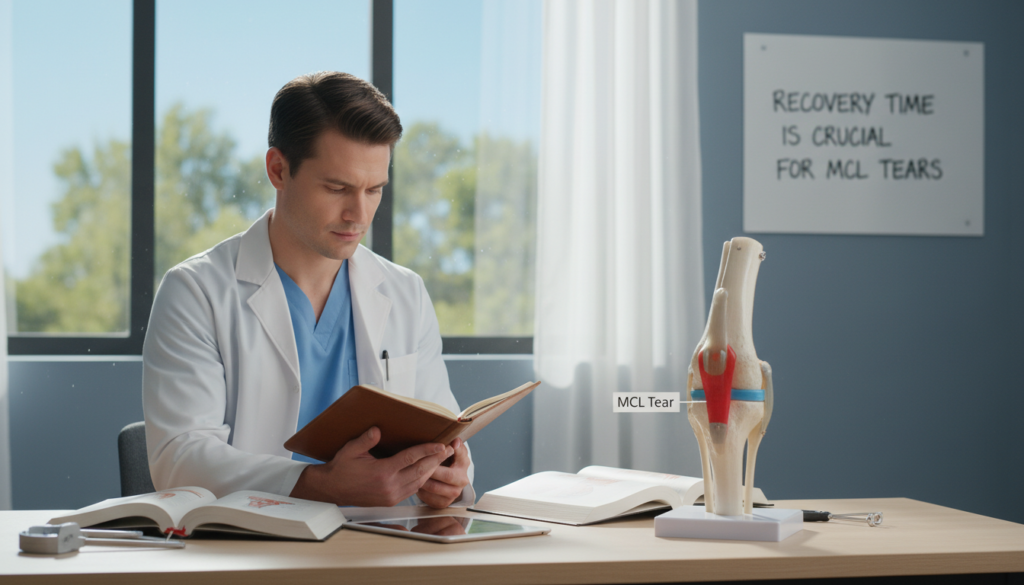
Recovering from an MCL injury involves distinct stages, each with specific goals and timelines. Setting realistic expectations is crucial for a successful rehabilitation journey.
The recovery time for an mcl tear varies significantly. It depends on the injury’s severity and your prior activity level.
Phases of Healing
Ligament repair follows a biological sequence. We guide patients through each step to ensure optimal tissue quality.
The initial inflammatory phase controls bleeding and swelling. Next, the proliferative phase builds new collagen fibers.
The final remodeling phase can last months. It strengthens the new tissue to handle stress.
| Healing Phase | Typical Timeframe | Primary Clinical Goals |
|---|---|---|
| Inflammatory | Days 1-7 | Manage pain, reduce swelling, protect the knee |
| Proliferative | Weeks 2-6 | Restore range of motion, reactivate muscles |
| Remodeling | Weeks 6+ | Progress functional strength, correct movement patterns |
Expected Recovery Timelines
Most non-surgical mcl tear cases show major improvement within a few weeks. A Grade I sprain may allow a return in 1-2 weeks.
Moderate Grade II injuries often need 3-6 weeks. Our focus is on regaining full motion and muscle control first.
Research supports these timelines. A study found elite soccer players often return to play within 3-4 weeks post-injury.
We monitor pain and swelling closely. Advancing too quickly can re-injure the healing tear.
Every patient’s journey is unique. Full recovery may take longer if foundational patterns need correction.
How does age affect MCL healing time?
The journey to mend a torn ligament unfolds differently for a 25-year-old athlete compared to a 55-year-old active individual. Our biological repair systems change over decades.
This directly shapes the rehabilitation path for a medial collateral ligament injury.
Age-Related Biological Changes
As years pass, the body’s natural healing capacity can diminish. Key factors include reduced blood flow and altered tissue composition.
A study by Rudzki et al. noted a significant drop in tendon blood flow for patients over 40. Similar changes likely affect the knee‘s ligaments.
Tenocyte activity and collagen production rates also naturally slow. This can extend the early phases of recovery from a tear.
Impact on Ligament Strength and Flexibility
The structural integrity of the MCL itself can be influenced by time. Age-related degeneration may make the tissue less resilient.
This can increase vulnerability to a new tear from repetitive stress. The inner side of the joint may respond differently to load.
Understanding these shifts allows us to customize therapy. We build programs that better support the ligament after significant injuries.
| Healing Factor | Younger Adult (Under 40) | Older Adult (Over 40) |
|---|---|---|
| Blood Flow to Tissue | Typically Robust | Often Reduced |
| Collagen Synthesis Rate | Faster | Slower |
| Tissue Elasticity | Generally Higher | Can Be Decreased |
| Typical Timeline for Grade II MCL Tear | 3-5 Weeks | 4-8 Weeks |
This table highlights why personalized care is non-negotiable. A one-size-fits-all plan does not work for knee ligament recovery.
The Role of Physical Therapy in MCL Rehabilitation
Professional guidance transforms the recovery process from a passive wait into an active rebuild. Our one-on-one physical therapy sessions are engineered to combat stiffness and restore stability.
We focus on two interconnected pillars: regaining mobility and rebuilding supportive muscle. This dual approach ensures the knee heals with optimal function.
Customized Exercise Programs
No two ligament tears are identical. Your program is built around your specific deficit patterns and goals.
We design exercises to reactivate muscles that protect the inner knee. This creates a dynamic brace around the healing mcl.
Improving Range of Motion
Restoring full, pain-free movement is a top priority. Early attention to range of motion prevents arthrofibrosis, a condition where the joint becomes stiff.
Gentle, guided movements keep the joint capsule mobile. This sets the stage for safe strength progression later.
| Recovery Phase | Primary Therapy Focus | Key Actions |
|---|---|---|
| Early Phase | Protection & Initial Mobility | Manage swelling, gentle range of motion exercises |
| Mid Phase | Progressive Strength & Control | Load the knee safely, correct movement patterns |
| Late Phase | Functional & Sport-Specific Training | Prepare the mcl for return to activity demands |
We continuously monitor your response. This allows us to adjust exercise intensity in real-time, matching your current healing stage.
Preventative Measures and Activity Modifications
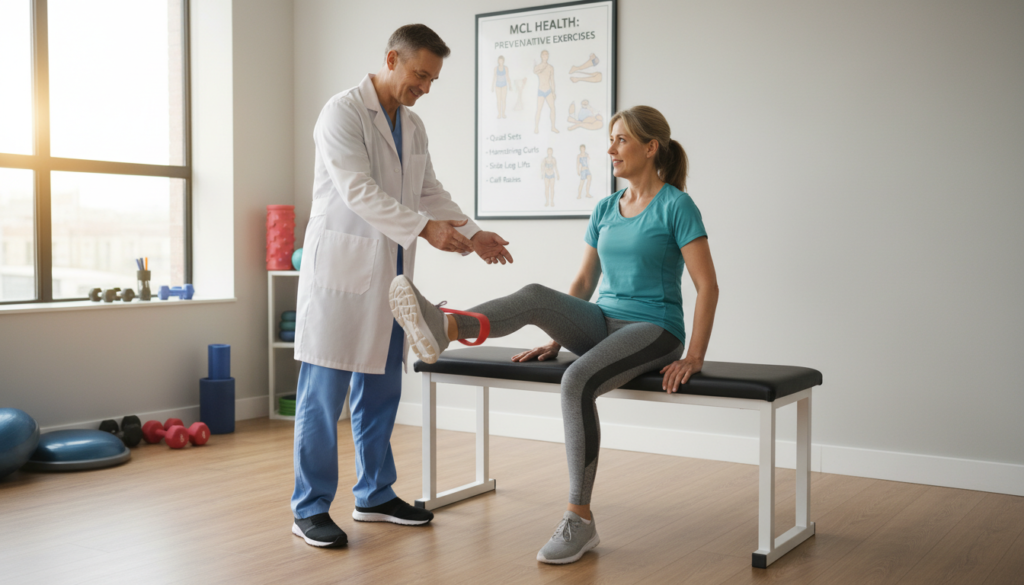
The way you land, pivot, and move during sports directly impacts your knee’s vulnerability. Smart habits form the best defense against a future ligament injury.
We focus on building awareness and control. This proactive approach helps you stay active with confidence.
Optimizing Landing Mechanics
Non-contact mcl injuries often stem from poor landing form. Training proper movement patterns is a powerful preventative tool.
We teach athletes to absorb force evenly. The goal is to avoid excessive inward rotation of the knee joint.
Modifying your activities is crucial when the inner side of the knee is vulnerable. This reduces repetitive stress that can lead to a tear.
We also emphasize environmental factors. A high-quality, even playing surface minimizes the risk of an unexpected twist.
Strengthening the muscles around the joint creates a natural brace. This is key for anyone prone to a ligament tear.
Our final goal is promoting safe sport practices. We help you minimize the chance of sustaining an mcl injury during high-intensity play.
Managing Pain, Swelling, and Inflammation
Successfully navigating the early stages of recovery hinges on mastering pain and swelling control. Effective management of these symptoms is critical during the first few weeks.
It creates the right environment for your body to repair the damaged tissue. We prioritize this to ensure a smooth rehabilitation process.
Pain Management Strategies
We utilize a multi-faceted approach to reduce discomfort after a ligament tear. The goal is to allow you to focus on essential healing exercises.
Initial strategies often include rest, ice, compression, and elevation (RICE). Anti-inflammatory medication may be recommended under a doctor’s guidance.
Our clinic also employs modalities like therapeutic ultrasound. These techniques help manage local pain and swelling effectively.
Monitoring Recovery Progress
Regular assessment of the knee is a cornerstone of our care. We track changes in swelling, range of motion, and strength.
Patients are encouraged to report any increase in pain. This feedback is vital, as it may signal that activity levels are too high for the healing tear.
Objective measures help us adjust your plan in real-time. Recent research underscores the value of closely monitoring inflammation to optimize outcomes.
| Recovery Phase | Primary Symptom Focus | Key Management Actions |
|---|---|---|
| Early Phase (Days 1-7) | Acute pain swelling | RICE protocol, pain medication, protected weight-bearing |
| Mid Phase (Weeks 2-4) | Residual swelling & stiffness | Progressive exercise, manual therapy, continued activity modification |
Keeping symptoms under control facilitates a more efficient rehab process. It helps your knee return to its pre-injury state of health.
Innovative Treatment Options for MCL Injuries
Today’s treatment landscape for MCL tears emphasizes minimally invasive techniques. Conservative treatment mcl options are often successful for partial tears.
The MCL is thick and has a strong innate capacity for repair. This makes non-surgical management a viable path for many.
Advances in Conservative Care
We explore modern methods that focus on biological healing and functional restoration of the knee joint. These innovative strategies prioritize preserving native tissue.
They also promote a faster return to daily activities. Our clinical team stays current with the latest research on ligament injuries.
This ensures we provide the most effective treatment for patients with complex knee issues. By integrating these techniques, we better support the healing of a tear.
This improves overall knee stability and outcomes. For more on personalized recovery factors, see our guide on the age impact on mcl sprain healing.
Comparing Non-Surgical and Surgical Treatment Methods
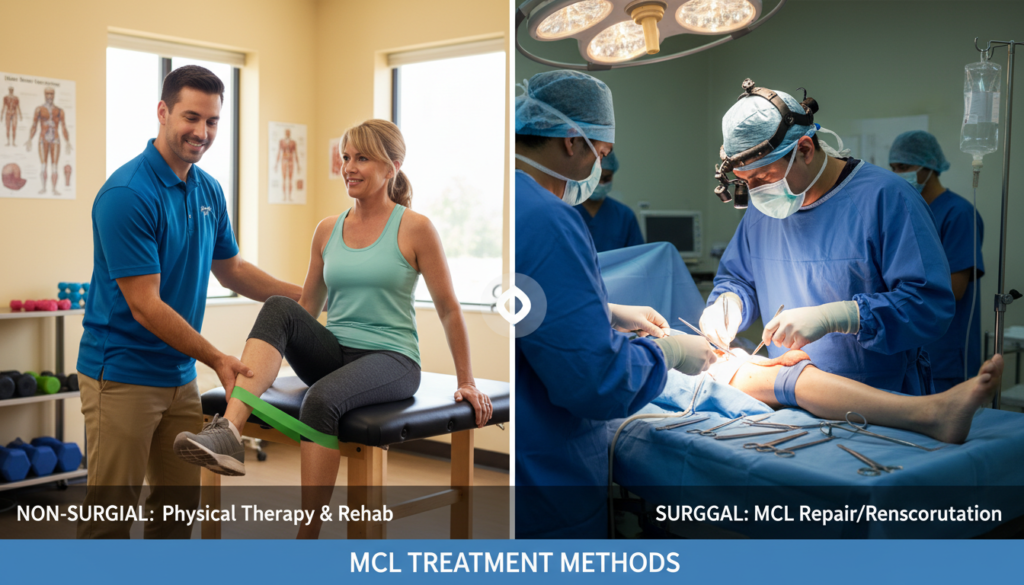
Not every medial collateral ligament injury requires an operation. Many heal robustly with dedicated physical therapy.
The best treatment path depends on the specific details of your knee tear. We help you navigate this critical decision.
Rehabilitation Versus Surgical Approaches
Deciding if you will need surgery for an mcl tear involves several factors. The injury’s size, joint stability, and your functional goals are key.
Surgical repair is typically reserved for larger, unstable tears. These are cases where conservative care has not provided enough stability.
| Approach | Typical Injury | Primary Goal | Recovery Focus |
|---|---|---|---|
| Non-Surgical Rehabilitation | Small to moderate sprains | Optimize the body’s natural healing | Restoring mobility and dynamic muscle control |
| Surgical Repair | Large, complete tears with instability | Mechanically restore the torn ligament | Protecting the surgical repair while regaining strength |
Our goal is to provide clear guidance. We compare long-term outcomes to inform your choice.
Both paths demand a committed partnership with your physical therapist. This ensures your knee regains full, safe function.
Influence of Age on Ligament Healing: Scientific Insights
Clinical data offers encouraging evidence for patients managing a ligament tear later in life. Scientific research provides deep insights into how our bodies mend these complex knee injuries.
Changes in Tissue Structure Over Time
The inner side of the knee joint undergoes gradual structural changes over decades. This evolution can influence the healing process for a medial collateral ligament tear.
Biomechanical stress on the knee joint is distributed differently as tissue composition shifts. Understanding these changes allows us to refine rehabilitation protocols for all age groups.
Evidence from Recent Research
A study of 102 MLKI patients at Lanzhou University Second Hospital showed no significant difference in functional outcomes between patients older or younger than 40. This suggests that while age influences tissue biology, it does not necessarily preclude a successful recovery from severe knee injuries.
By analyzing clinical cohorts, we see the healing process for a tear remains robust across the lifespan. For a detailed look at personal factors, explore our resource on the age impact on MCL sprain healing. This data reinforces that a torn MCL can heal effectively with proper care, regardless of chronological age.
Expert Tips for Navigating Your Knee Injury Recovery Journey
Navigating the ups and downs of injury rehab requires a strategic approach to staying on track. The mental challenge often matches the physical work needed to heal a ligament tear.
We see many patients struggle with consistency after the initial urgency fades. That’s why we focus on building sustainable habits from day one.
Strategies for Staying Motivated
Setting small, measurable goals creates a clear path forward. Celebrate walking without a limp before aiming for a run.
Tracking your progress in a journal provides powerful visual proof. You can see how far you’ve come since the tear first happened.
Connecting with our supportive team at JACO Rehab offers crucial encouragement. We help you push through plateaus when the inner side of your knee feels stiff.
Recovery is not a straight line, but every step forward counts.
Remember that each small victory brings you closer to your favorite activities. This positive outlook is fuel for your recovery journey.
| Recovery Phase | Common Motivation Challenge | Our Expert Strategy |
|---|---|---|
| Early Phase (Weeks 1-3) | Frustration with limited mobility | Focus on daily range-of-motion wins; use pain-free movement as a milestone. |
| Mid Phase (Weeks 4-8) | Boredom with repetitive exercises | Introduce new, functional variations; connect each exercise to a future sport goal. |
| Late Phase (Weeks 8+) | Impatience to return to full activity | Use performance testing to show objective strength gains; simulate sport-specific drills. |
This structured approach keeps you engaged throughout the entire process. A managed MCL recovery relies on both body and mind working together.
Your commitment to the process determines the final outcome. We are here to guide you every step of the way back to a strong, stable knee.
Rehabilitation Exercises and Strength-Building Strategies
The path to a strong, stable knee after an injury is built through targeted, progressive exercise. We design programs that systematically restore function and confidence.
Progressive Strengthening Techniques
We implement progressive techniques to rebuild muscle mass lost after an mcl tear. This approach gradually increases load to restore the knee’s stability.
Our rehabilitation exercises are carefully selected. They improve range of motion and overall strength without placing excessive stress on the healing mcl.
Consistent therapy sessions allow us to monitor the joint’s response. We ensure the tear remains protected during the strengthening process.
Building strength in the quadriceps and hamstrings is essential. These muscles provide dynamic stability to the knee after an mcl injury.
Our structured approach ensures each patient develops necessary strength. The goal is a full return to pre-injury physical performance.
Sports-Specific Return-to-Activity Guidelines
Our sports-specific protocols bridge the gap between clinical recovery and game-day demands. A healed ligament is just the starting point for a safe return.
We design these guidelines to match the unique stresses of your sport. This careful planning minimizes the chance of a new knee tear.
Gradual Transition Back to Sports
Returning to sports like football requires a phased approach. Athletes begin with light, controlled drills before any contact.
We monitor how the joint feels during every practice session. This allows us to adjust the intensity of activities in real time.
Athletes must pass objective stability and agility tests first. These benchmarks prove the knee is ready for competitive play.
This structured transition is critical. It ensures the mcl can handle sudden pivots and impacts without re-injury.
Following evidence-based return-to-sport criteria is a cornerstone of our practice. It provides a clear, safe roadmap for athletes after a significant ligament tear.
By adhering to these guidelines, you can return to your sports with confidence. The goal is a strong, resilient knee for the long term.
Integrating Multidisciplinary Care in Knee Injury Rehabilitation
A truly comprehensive recovery from a complex knee injury demands more than a single perspective. When a significant ligament tear occurs, especially with other structural damage, a unified team approach is essential.
This method ensures every aspect of the trauma is addressed. It leads to more complete and sustainable outcomes.
Coordinating with Physical Therapists and Specialists
We build a collaborative network around each patient. Our physical therapy team works directly with orthopedic doctors and other specialists.
This coordination creates a single, powerful treatment strategy. It targets the mcl tear while supporting the entire joint.
Regular communication is the backbone of this model. We share progress notes and adjust the rehab plan in real time.
This responsive system tracks the healing tear closely. It allows for swift modifications if the knee needs more support.
The result is a supportive environment that promotes faster recovery. Our goal is lasting health for your joint after serious injuries.
This therapy philosophy turns complex cases into success stories. A team effort provides the best path forward.
Real-Life Recovery Stories and Outcomes
Real-world examples of patient success stories provide tangible hope and a clear roadmap for recovery. We believe seeing is believing.
Patient Testimonials and Case Studies
Our patients’ voices are the strongest testament to our approach. They share their journeys from diagnosis through rehabilitation.
These narratives highlight the critical role of persistence. Professional guidance helps navigate each phase of healing.
Case studies offer a detailed look at individual paths. They show how tailored programs address specific challenges.
Seeing others succeed after a ligament tear provides powerful motivation. It reinforces commitment to your own rehabilitation goals.
| Patient Profile | Injury Details | Rehabilitation Focus | Key Outcome |
|---|---|---|---|
| Weekend Warrior, 50s | Grade II MCL tear on inner side | Restoring stability, building quad strength | Returned to hiking in 10 weeks |
| Collegiate Soccer Player, 20s | Complex knee injury with MCL tear | Sport-specific agility and plyometrics | Cleared for full competition in 8 weeks |
| Active Retiree, 60s | Chronic MCL instability from old tear | Improving proprioception, gait training | Regained pain-free daily activities |
These outcomes demonstrate that with dedicated effort, a full return to activity is possible. Our team is here to support your journey after knee ligament injuries.
Conclusion
Your journey back to strength after a knee injury is a testament to your resilience and smart care. We have explored how personal factors influence tissue repair and provided strategies for effective rehabilitation.
Remember, each ligament tear is unique. Success hinges on commitment to your physical therapy and strength program. Patience during this process protects your long-term joint health.
Understanding your knee‘s anatomy empowers you. You can take proactive steps to shield it from future stress during sports or daily activities.
Our team at JACO Rehab supports athletes returning to football and individuals recovering from everyday incidents. We ensure you are on track to regain full function after MCL injuries.
Contact us today for guidance. Stay focused on your goals, listen to your body, and trust the process as you heal and move forward with a strong, stable knee.